
BOS Semiconductors Presents Chiplet-Based AI Accelerator ‘Eagle-N’ at Hot Chips 2026


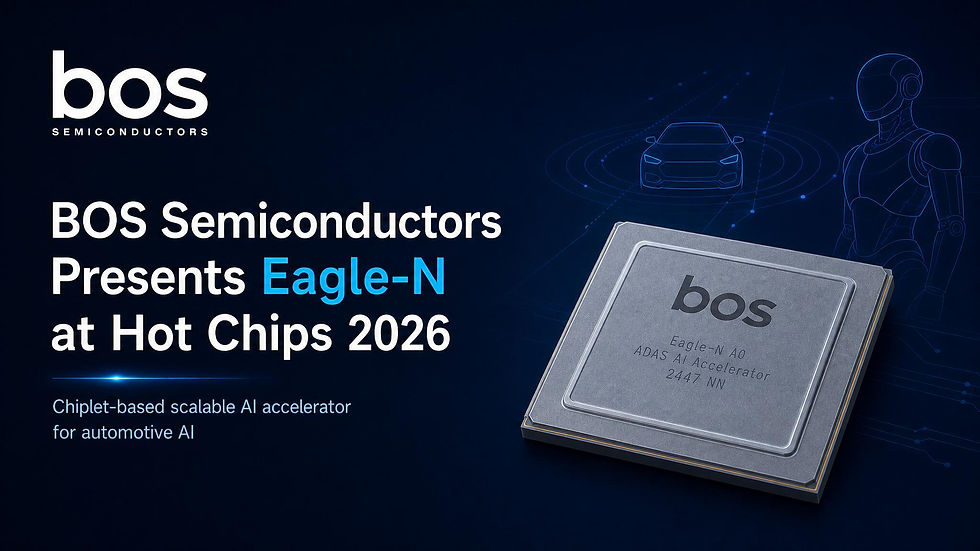
BOS Semiconductors, a fabless semiconductor company developing AI chips for automotive, robotics, and Physical AI applications, showcased its technology on the global stage by presenting its next-generation AI accelerator, Eagle-N, at Hot Chips 2026, one of the world’s leading semiconductor technology conferences, held at Stanford University in the United States from August 23–25.
Since its inception in 1989, Hot Chips has been recognized as one of the industry’s premier conferences for introducing next-generation semiconductor technologies and architectures. This year’s program featured presentations from leading global semiconductor and AI companies, including NVIDIA, Intel, AMD, Arm, Google, IBM, Broadcom, and Micron.
BOS Semiconductors presented “Eagle-N: Scalable Chiplet-Based SoC for Automotive AI” during the Automotive session on August 24. The presentation was delivered by KM Lim, CTO of BOS Semiconductors, who oversees the company’s hardware development. Dr. Lim is a semiconductor design expert with more than 20 years of experience at Samsung Electronics, where he led mobile and SoC development and played a key role in developing automotive semiconductors for global automakers. Waymo, a U.S.-based autonomous driving technology company, also presented during the same session.
During the presentation, BOS Semiconductors highlighted how the competitiveness of AI semiconductors is increasingly determined not simply by raw compute performance measured in TOPS, but by how quickly and efficiently massive amounts of data can be moved between memory and compute units as AI models continue to grow in size and complexity.
To address this shift, Eagle-N incorporates a next-generation NPU architecture designed around data movement efficiency. Through shared memory across compute clusters, a Network-on-Chip (NoC)-based interconnect, and dedicated processors for data movement, the architecture is designed to improve compute-unit utilization while minimizing memory bottlenecks. This enables Eagle-N to efficiently support a broad range of AI workloads, including large-scale Transformer models and generative AI, as well as workloads required for automotive, robotics, and other Physical AI applications.
Physical AI systems operating in real-world environments, such as vehicles and robots, must process multiple AI workloads simultaneously rather than running a single AI model. These workloads may include environmental perception, driver and occupant monitoring, generative AI, and control. Eagle-N incorporates virtualization technology that partitions the NPU into independent execution environments, enabling multiple AI workloads to run independently and in parallel on a single AI accelerator.
Automotive AI is rapidly evolving from conventional CNN-based perception algorithms toward Transformer-based AI, while robotics and Physical AI applications are increasingly adopting large-scale AI models for real-world perception, reasoning, and control. Eagle-N is designed with a flexible architecture that is not limited to specific AI models, making it easier to accommodate evolving models and workloads while addressing diverse AI computing requirements.
Another key feature of Eagle-N is the scalability of AI computing performance enabled by its chiplet architecture. Chiplets are an advanced semiconductor design approach in which a large monolithic chip is divided into smaller functional dies that can be combined as needed, allowing system configurations to scale flexibly according to performance requirements.
Based on this chiplet architecture, Eagle-N is designed to scale computing resources according to required AI performance and system requirements. This provides the flexibility to address the diverse needs of OEMs across vehicle segments ranging from mid-range to high-end, while also establishing a foundation for expansion into robotics, Physical AI, and other applications that demand increasingly high levels of AI computing performance.
Jason Chae, Executive Vice President and Head of Strategic Sales & Marketing at BOS Semiconductors, said, “Being selected to present at Hot Chips alongside some of the world’s leading semiconductor companies is particularly meaningful, as it demonstrates international recognition of BOS Semiconductors’ technology and vision for next-generation automotive AI semiconductors.”
He added, “We will continue to advance our AI semiconductor architecture with a focus not only on raw compute performance, but also on data movement efficiency and scalability. By enabling flexible adaptation to rapidly evolving AI models and computing environments, we aim to strengthen our global competitiveness in the Physical AI and automotive AI markets.”


